
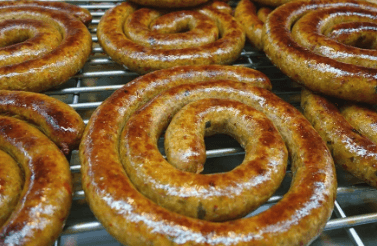
Chiang Mai Sausages with waterfowl
A souvenir from a 2014 road trip through northern Thailand.
Prep45 min
Cook20 min
YieldAbout a dozen sausages
LevelEasy
Ingredients
Sausage blend
- Ground migratory bird meat, geese, snow geese or ducks, coarse grind1⅛ lb
- 85% fat ground pork, 75-85% fat — aim for 30-40% final fat in the total blend1⅛ lb
- Salt15 g
Seasoning paste
- Fresh galangal, chopped, 1 tablespoon — not ginger, it's different1 tbsp
- Fresh cilantro, chopped, 2 tablespoons (stems + leaves)2 tbsp
- Fish sauce (nam pla), 2 tablespoons — Squid Brand or Golden Boy2 tbsp
- Green onions, or French shallots7
- Fresh lemongrass, chopped, 2 tablespoons (tender heart only)2 tbsp
- Kaffir lime leaves, 10 to 15 leaves, remove the central rib12
- Garlic clove, about 30 g, peeled6
- Fresh Thai chilies, 5 to 10 depending on heat tolerance — it's serious7
Steps
- 01Pass the migratory bird meat and the pork separately through a meat grinder on the coarse plate. No grinder? Ask your butcher to do it. Refrigerate both ground meats while you make the seasoning paste — they need to stay very cold to bind well later.
- 02In a food processor (or a powerful blender), combine the salt, chopped galangal, fresh cilantro, fish sauce, roughly chopped green onions, chopped lemongrass (tender heart only — the rest is too fibrous), kaffir lime leaves (remove the central rib or it'll thread through the paste), peeled garlic and Thai chilies (with or without seeds depending on heat). Pulse for 10 to 15 seconds, add a splash of water, pulse another 30 seconds until you get a smooth semi-liquid paste.
- 03In a large stainless steel bowl that's very cold, combine the ground bird meat and pork. Pour the seasoning paste over the top. Mix by hand for 4 to 5 minutes, kneading energetically, until the paste is evenly distributed and the mixture turns distinctly tacky. That tackiness is what gives you a juicy sausage.
- 04Cover the bowl with plastic wrap pressed directly onto the surface (no air gap). Refrigerate 24 hours. This step is non-negotiable — the flavors need time to soak through, and the texture improves dramatically. The next day, pull it out 30 minutes before stuffing so the mix is malleable.
- 05Before stuffing, take a small patty of the mix and pan-fry it for 2 minutes. Taste. This is the only moment to adjust — fish sauce, salt, chili. Once it's in the casing, too late. Note that the flavors will keep developing after the final cook too.
- 06Two hours before stuffing, soak the pork casings in a large bowl of warm water to desalt. After 30 minutes, change the water. Before using them, run water through the inside of each casing to rinse thoroughly and check for any holes.
- 07Set up the sausage stuffer (or the grinder's stuffing attachment). Slide a casing onto the nozzle, accordioning it fully. Tie a knot at the end. Stuff at a steady pace, avoiding air pockets. Once the casing is filled, twist every 12 to 15 cm to form individual sausages. Count about a dozen sausages from this batch.
- 08To serve, two options. On the grill: medium heat, 4 to 5 minutes per side, lightly pricking the sausages with a fork to prevent bursting. In the skillet: medium-low heat with a touch of vegetable oil, flip every 2 minutes, count 12 to 15 minutes total. Serve with jasmine rice, vinegared cucumber slices, and a bowl of nam jim sauce for dipping. No knife, no fork — fingers and chopsticks.